
Introduction:
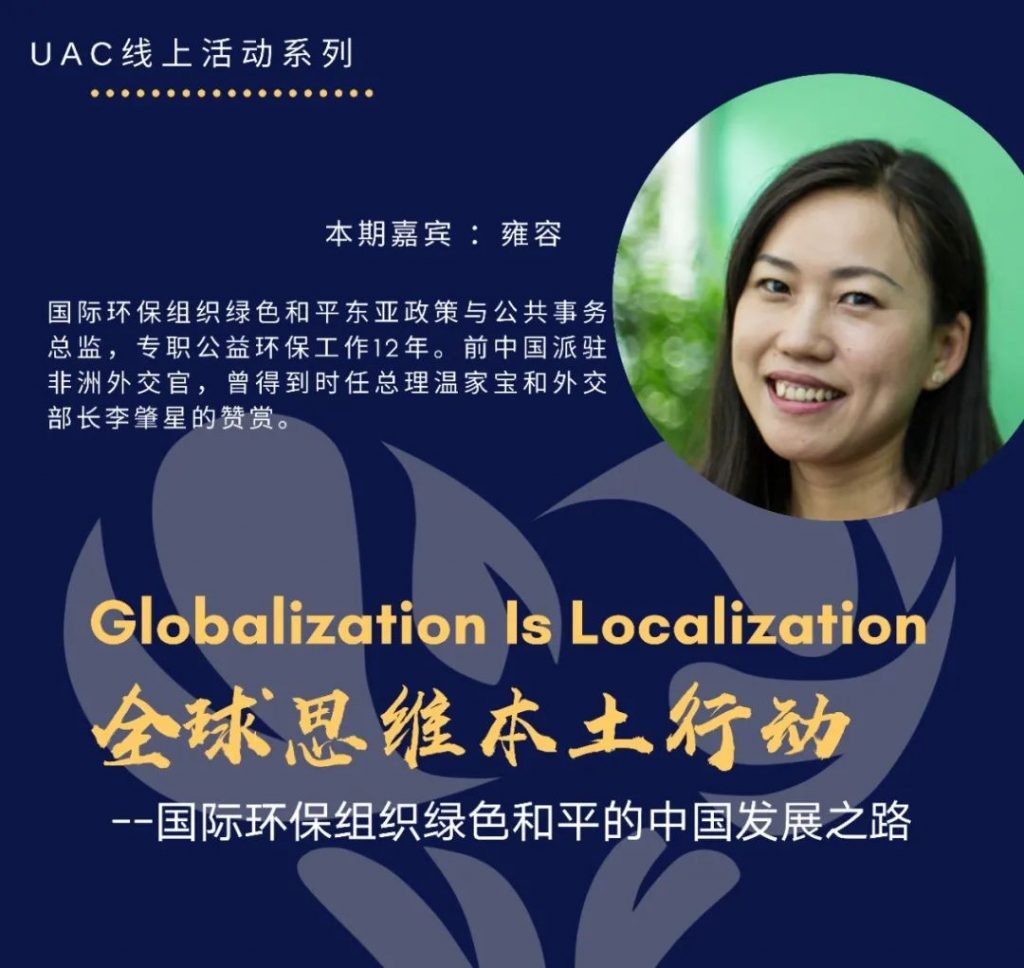
Ms. Yong Rong works full time in the nonprofit sector and is currently Director of Policy and Public Affairs for East Asia at the international environmental organization Greenpeace. She is responsible for Greenpeace’s overall strategy for establishing and growing itself locally in mainland China, planning and carrying out its work strategies and programs. She founded Greenpeace’s policy and external relations department and helped the organization grow quickly, from just over 10 people in 2008 to nearly 80 full-time staff today.
Those who know her call her “Xiao Fei” (Little Africa), because she was once a Chinese diplomat posted to Africa. She worked in Tanzania for many years, handling the consular section’s daily work and the protection of Chinese nationals, promoting China–Tanzania relations and safeguarding the legitimate rights of Chinese citizens there. She helped host dozens of Chinese government delegations visiting Tanzania and was commended by then-Premier Wen Jiabao and Foreign Minister Li Zhaoxing.
Curious already?
– A diplomat who switched careers to a nonprofit NGO?
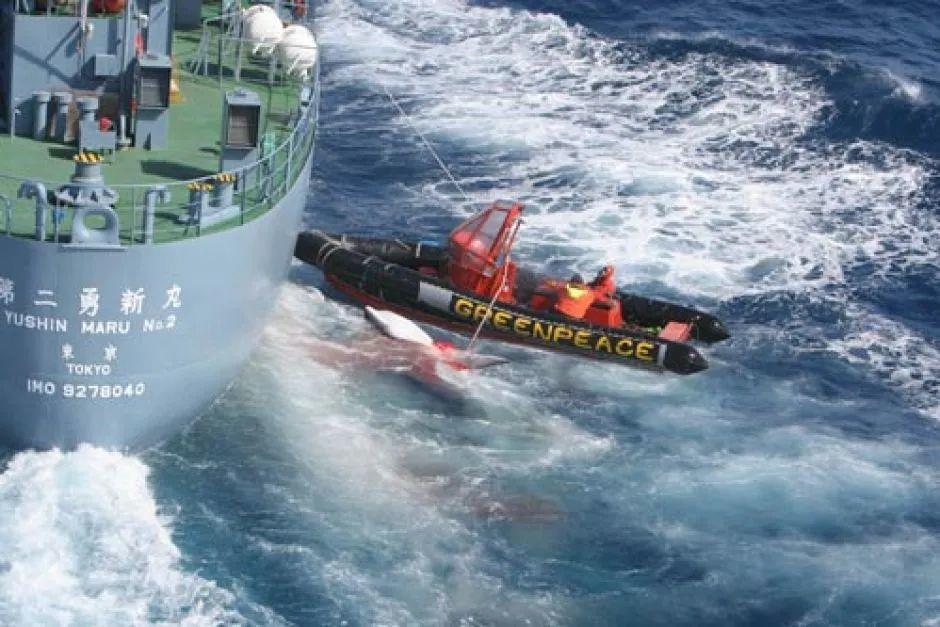
– The most memorable image of Greenpeace is probably a small boat on the high seas confronting a huge Japanese whaling ship to protect the whales. So what environmental work does this very cool-looking organization do today?
– And what has Greenpeace done in China?
– Why do we say “Globalization Is Location”?
Below are the video of Ms. Yong Rong’s talk and an edited transcript. We hope they answer some of your questions. Ms. Yong Rong’s views are her own and do not represent Greenpeace or UAC.
Editor’s guide (topics and video timestamps):
- Why a diplomat became an NGO professional – video 0:00:24
- How Greenpeace developed: origins – 0:07:12; the first decade, the 1970s to early 1980s, the start-up years – 0:15:39; the second decade, the 1980s–90s, the growth years – 0:18:50; the third decade, the 1990s–2000s, maturity – 0:21:50; today, transformation – 0:25:20
- What Greenpeace does in China – 0:29:12; the 2008 Wenchuan earthquake – 0:37:13; the 2008 Beijing Olympics and Beijing’s 2015 Olympic bid – 0:40:52
- Why “think globally, act locally” – 0:45:22
1
Why did a diplomat become a full-time NGO professional?
Q: Why did you move from a government department to a non-governmental organization – from diplomat to full-time NGO professional?
A: Because of Africa. It was while working in Africa that I first met people working in charity. As everyone knows, there is a lot of disease, poverty and war there. China has a system of “big government, small society”, but many Western countries – and many African countries too – have “small government, big society”. So over there we met all kinds of people doing charitable work: in the UN system, in international organizations, in local organizations, and in volunteer-run groups like yours. And I found they all had something in common: love – it was all a giving of love, and I was really moved. Later I got pregnant and returned to China, and after a year as a full-time mom I started looking for work again. Because of my child I wanted more time to balance work and family, and I wanted to find a freer, more loving community, so I came to the NGO world. I happened to see a Greenpeace job posting. I had heard of them – small boats on the high seas charging at Japanese whaling ships to protect the whales – and thought that was pretty cool, so I sent in my résumé. They were looking to develop in China and wanted people who understood China, which is especially important there. As I just said, in a “big government, small society” setting the government’s role is crucial: it makes the policies, manages society, sets the rules and enforces them. If NGOs, especially international NGOs, want to develop in China, they need to understand China, its government, and how government officials think and work. Since I happened to have a government relations background, it was a good fit, and so I started working at Greenpeace. Environmental protection is an issue I care about – I think everyone wants cleaner air and safer food. Greenpeace really wants to understand local conditions and get real things done, so it was willing to hire a Chinese person like me, with no overseas education and a background in government. And so I stayed on, right up to today.
In 2008 I started working on policy and public affairs at Greenpeace. We now have a small team of three. Our main job is communicating with government departments: first, to understand the issues they are focusing on; second, to understand their thinking as they implement existing policies, or the pain points they describe. If we have suggestions, we want them to know our policy asks. If we find problems, we raise them with them too. So we mainly deal with government departments.
2
Globalization – how Greenpeace developed
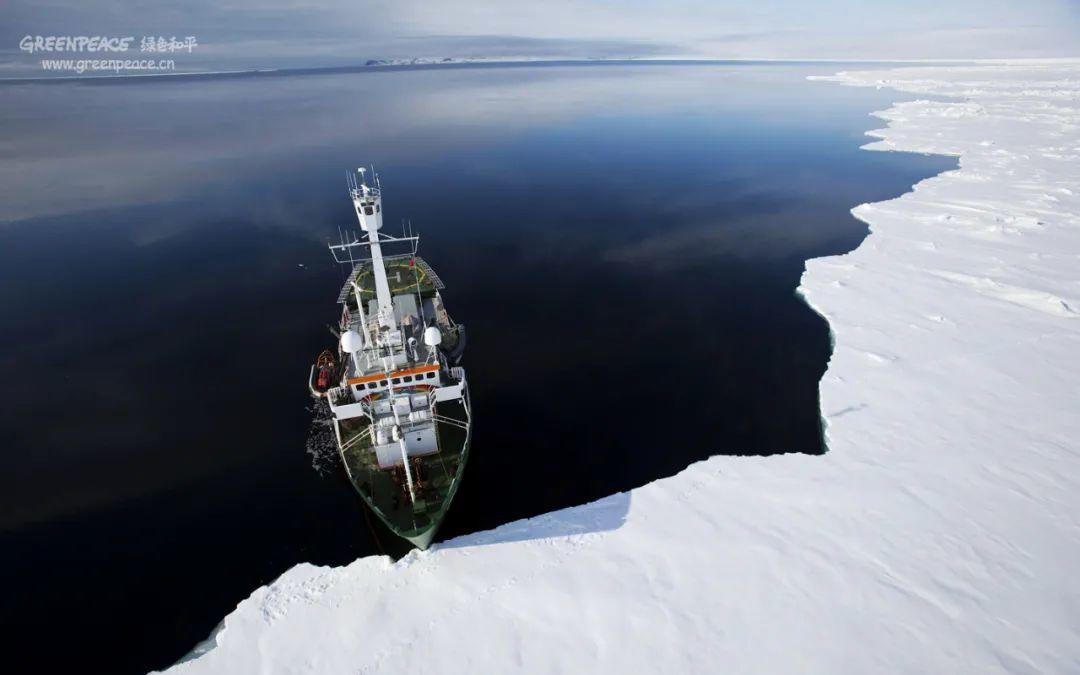
Greenpeace is a big organization, but every organization starts from the beginning. I’d like to share how a small organization in the 1970s became a global network of over 2,000 people in 50 countries and regions, what kinds of projects it does, and how it raises money. Our slogan is Positive Change Through Action, so we put great emphasis on action, and we want that action to produce results – positive change. Our core work is finding environmental problems on the front line, analyzing them and solving them. We were founded in 1971, so we’re over 40 now – middle-aged, you might say. Our headquarters is in Amsterdam in the Netherlands, and we have offices in 50 countries and regions around the world.
Origins: It all began in 1971. America was just climbing out of the quagmire of the Vietnam War. A group of 12 young Americans went to Vancouver: they had heard the US government was going to conduct a nuclear test on an uninhabited island, so they rented a boat at the Vancouver docks. They wanted to do something meaningful – perhaps ordinary people can achieve great things. On the way they came up with a name, Greenpeace: green for the issue we wanted to work on, peace for our hopes for the future of the world. They hastily made some flags reading “Green Peace”. But the trip didn’t actually succeed. On the high seas they ran into the US military and were stopped. What our predecessors did was not to confront them, but to give them peace doves folded from paper, because theirs was a peaceful, non-violent protest. In return they received a thank-you letter from the servicemen, saying: “Our duty is to turn you back and not let you reach the island. But as individuals, we respect your courage, and we admire you for doing this.” So they returned to Vancouver harbor feeling dejected. Interestingly, though, the wife of one of the 12 was a journalist in Vancouver who had been reporting on it to the Vancouver media every day. So when these 12 young people came back to Vancouver, crestfallen and feeling they had failed, they got a hero’s welcome. The public knew all about it and said: “Your courage is commendable. Even though you didn’t succeed, you showed your courage, and we admire you for it.”
That experience made these young Greenpeace founders decide to keep going. An individual’s strength may be small, but public opinion can be powerful. Our way of working is non-violent direct action: we do not use violence, but we take direct action. From then on, this became one of Greenpeace’s core values and working principles. We believe that through the power of the public and non-violent direct action, we can win the battle for the environment.
We have about 2,000 full-time staff like me, and 3 million supporters who are our donors – members of the public who give us money. To ensure Greenpeace’s impartiality and independence, at no national level do we accept any money from governments, corporations or political sources; we accept only direct donations from individuals and independent foundations. What is an independent foundation? Say Jack Ma set up an Alibaba Foundation – we wouldn’t take its money, because it’s a corporate foundation. But if Jack Ma set up a personal foundation, the Jack Ma Foundation, and we could confirm there was no company behind it, that it wasn’t advertising for a company or promoting corporate values, then we could accept its money. So we only accept direct donations from individuals and independent foundations.
Most Chinese people probably know Greenpeace for its anti-whaling campaigns. I chose an anti-whaling photo here. Greenpeace is very good at showing the small taking on the big. See the little speedboat in the lower left of the photo? Someone on it is standing up taking pictures. Our boats always carry our campaigners – we run campaigns – and our staff, plus media or our photographers, because we need to document everything. We know very few people are there on the scene, so we need images to let many more people know what’s happening. Only when something becomes a matter of public concern can it have influence and drive change. That’s why we work this way, sometimes even putting ourselves in danger.
In the early days this way of acting was somewhat radical – charging straight to the front line of the problem. It was very Western, and very much of its era. Today things are different, not only in the West but in many places. But that original fighting spirit – facing problems fearlessly, even creating confrontation to draw public attention, taking direct action, sometimes at personal risk – has stayed in our organization’s DNA. Look at Greenpeace around the world today and you’ll see we haven’t given those things up; the genes haven’t changed. But we as people grow up, and so does the organization – we can’t forever be impulsive guys in our early twenties. So we can see four decades of change in our organization globally. There’s no official internal version of this; it’s my own account, written in Chinese.
The first decade – the 1970s to early 1980s: the start-up years. Back then, the environment wasn’t the hot topic it is today; public environmental awareness was only beginning to rise. So one of our most important tasks was drawing public attention to environmental problems. We used brave, sometimes radical, almost crazy actions to awaken people to environmental destruction. We were also lucky that this coincided with the rise of mass media – newspapers and radio were huge then. Back then many Americans heard each new president’s speeches on the radio. As these media emerged, we wanted to use them to increase our influence. Everything takes money, right? Even our first trip needed a rented boat, so fundraising has been one of our most important jobs from the very beginning. Our predecessors had no money, so we needed donations. Getting into the newspapers and drawing public attention was linked to fundraising: through our media exposure, and by letting the public see our courage, we received donations. We received unrestricted donations and organizational donations. Organizational donations means people give not for a particular project (not to fund an anti-whaling or anti-nuclear project), but to Greenpeace as an organization – they trust the organization and are happy for it to do any project. Unrestricted means the money has no fixed purpose. Sometimes you receive money earmarked for, say, a nursing home project; it can only go to that project, not to staff salaries – that’s a restricted donation. So early on we started seeking organizational and unrestricted donations. We also hoped for recurring donations, but we didn’t turn down one-off gifts, because we were just starting out, and most of the time the public gave to us once. There were also some project-specific donations. That was the first decade.
The second decade – the 1980s to 1990s: the growth years. This was also when global environmental governance entered a new stage. The world’s three major environmental conventions – on climate change, biodiversity and desertification – all came out in the eighties and nineties. This photo is of the 1992 Rio Earth Summit, which made the environment a major issue at the table of global government negotiations. It was no longer just military or disarmament talks; environmental negotiations became global negotiations too.
Greenpeace took part as well. We were full of hope and optimism about intergovernmental cooperation and the UN environmental conventions, so Greenpeace people began taking part in international negotiations as professional environmental observers. I myself went to Brazil for the 2012 conference marking the 20th anniversary of the Rio Earth Summit. We had to build up our professional capabilities: as observers in international negotiations we could listen to what politicians were saying and even speak. That meant we needed technical knowledge, political understanding, strategic planning and lobbying skills. But we didn’t forget our original role of exposing major environmental problems. If there’s a problem, we still have colleagues charging to the front line, because that is what first won us the public’s recognition – it’s who we are and where we come from.
A new way of giving appeared in this era: regular giving. Before, we talked about one-off donations; regular giving means monthly or quarterly donations. Regular giving lets the organization develop sustainably. With monthly giving, it’s like a monthly paycheck: every month our supporters give us money, a continuous and stable source of funds. When fundraising, we work hard to make donors understand that they give to Greenpeace because we do what they cannot do; if anyone could do it, they could give to anyone. So we need to find what is unique about the organization. Courage is one thing that makes us unique, and now our professional participation in international negotiations is another. So people give to Greenpeace not only because they think we’re really cool and really brave, but also because they truly endorse what we do and see that it is genuinely different.
The third decade – the 1990s to 2000s: maturity. The 2000s were a time of great global economic growth, and our organization entered maturity. We had done a lot of work with the public and with governments, and now we started working with businesses, because multinational corporations had become so powerful. The 2000s saw the rapid development of the internet and globalization; the global carbon footprint and influence of many multinationals exceeded that of many countries. So we realized that exposing corporate problems could have an enormous impact on human society – and that if companies changed, they could in turn push policy change. This photo is of the HP building under the Guomao Bridge in Beijing. Globally we ran a campaign against HP’s use of toxic substances – about electronic waste in computers. The computers we use contain many harmful substances, and we wanted HP to stop using these toxic substances and switch to more environmentally friendly ones. As a global organization, we ran this as a worldwide action. In the middle is my colleague, with volunteers on the left and right, wearing protective suits and gas masks. Not because Beijing was really toxic, but because we used this kind of performance art to get our core message across. The event drew a lot of media attention, and we made the headlines. But that was only the tip of the iceberg. Before that, we had a great deal of communication with the company, and on the spot we delivered an open letter asking its senior management to come and receive it. We also communicated with many members of the public online by email, telling them what we were doing. And even more important were two words: online petition. Our letter was signed by tens of thousands of people around the world who supported the action. In other words, it wasn’t just Greenpeace taking on HP; tens of thousands of people worldwide were calling on HP together. So the public went from being spectators watching us in the media to being part of us, part of the environmental movement. Our fundraising changed too. As I said, the public were no longer just spectators; they were participants and activists. So our fundraising became more closely tied to our project work, giving our supporters a greater sense of belonging. We also need to show people that their donations are useful – that we not only did things but achieved results – so we work hard to show the results of our work. At the same time we tell people that environmental problems can’t be solved overnight, and that the importance and long-term nature of these issues really matter. Maybe the action we took at HP only got it to promise that in ten years it would stop using toxic substances in its computers – there are still ten years to go, and we don’t know whether it will deliver. So often the importance of an issue still needs more publicity, so people can see that even if there are no immediate results, if the direction is right the public will support us.
Today: transformation. It’s hard to capture Greenpeace’s current global situation in a single picture, so I used a jumble of many images, which I think really represents how changeable, complex and even chaotic today’s world is. It often leaves people at a loss, so they start avoiding problems or even denying them. Take climate change: the public is actually tired of it; they’ve heard about it for too long. But has the climate really changed? Aren’t temperatures rising? Where are the results? Because of the internet’s algorithms and echo chambers, more and more people feel they live inside their own communities, paying close attention only to the issues they care about. People’s individuality shows very strongly, and everyone expects more personalized information and personalized services.
And of course, as the pandemic shows so well, globalization faces huge challenges. Everyone is turning inward and pulling back, paying more attention to what’s around them and to local issues. Just saying a problem is serious isn’t enough – where’s the solution? That is the big challenge today’s world poses to us. So that’s roughly how Greenpeace has developed globally over four decades – which is why we’re in our forties now.
Q: What is Greenpeace doing now?
A: We still work in three areas. First, we can’t lose our original DNA: if there’s a problem we will still speak up, and since raising public awareness is never finished, we still need to keep doing it. Second, we also know that just talking about problems is far from enough, so more of our work now focuses on solutions. Climate change is serious – what do we do? Air pollution is serious – what can we do? So we offer more solutions. And third, when we involve the public, we make sure they hear more information from more sides, so they can take part in our work more rationally and professionally, and in many different forms.
Because of this, our fundraising team is now a very large one. To give you a rough figure: for every 10 yuan Greenpeace receives, we spend about three going back into fundraising – roughly that ratio. That includes hiring professionals to design professional fundraising approaches, giving different audiences different information and different services. We have many levels of giving: small and medium gifts, monthly and quarterly giving, and different methods – for example “buying clean air”, buying an air purification system – all sorts of ways to donate. So fundraising requires investment; it’s not just a matter of telling people about our projects – fundraising has to be done professionally. We want our supporters not only to see Greenpeace’s values, share them and see that our work is effective, but also to feel that we’re not just a bunch of angry young people: we’re professional and focused on solving problems. Only when you help others do they feel you are worthwhile, and so they are more willing to help Greenpeace.
3
Localization – Greenpeace in China
We came to Beijing in 2002 – coming to Beijing meant coming to China. What do we do in China? At first we rented a small room at Minzu University of China and put on a small exhibition. Starting from that exhibition, we brought in a lot of work from abroad and made it into booklets – we began with public outreach and have kept going to this day. When I joined Greenpeace in 2008 it had just over ten people; now we have more than 80 full-time staff, not counting volunteers and our donors and supporters. One thing we emphasize strongly is finding our own role. China is so big, and China’s environmental impact affects not just China – it matters enormously for sustainable development worldwide. So we hope China makes a green transition, and what can Greenpeace do in that transition? Our strength is small; we want to be an accelerator of the transition, so that the transition happens a little faster. A problem that might have taken 10 years to solve could, thanks to Greenpeace’s work, be solved in nine and a half years, or eight. That’s our role: an accelerator.
So what do we do in China? First, when there’s a problem, we still expose it. This is a coal pollution problem in the Qilian Mountains – see the little fox in front? When humans plunder resources to satisfy their desires, it has a huge impact on ecosystems and wildlife. That project drew wide national media attention, but we also came under a lot of local pressure. We will keep exposing environmental problems, but we found a policy anchor: China has an “ecological red line” policy, so we expose problems to help implement the ecological red line policy. This is our forest project. We discovered many cases of deforestation, and rather than just releasing it to the international media as I described earlier, we now more often inform the government, because if a problem is real, once the government takes action the effect is much stronger than anything an NGO can achieve. In 2014 the Zhejiang Provincial Forestry Department carried out a very serious investigation, and it later became the top case on the State Forestry Administration’s list of the ten biggest national cases in 2015 – quite an impact.
Third, while exposing these problems, we also need to find policy windows. We knew China was drafting chemicals policy at the time, so we hoped that during that window our work could feed our views into the policymaking process. We did a series of projects on wastewater and chemicals that sparked a great deal of discussion, especially in the media, so policymakers also began paying attention to chemicals when drafting policy. In China, before our project, what were chemicals considered? A matter of safety and dangerous accidents, handled by the State Administration of Work Safety; the environmental authorities didn’t manage chemicals at all, so they only got attention when there was an explosion or people died. A big part of our work was pushing chemicals management upstream – managing them before an accident happens. We ran a series of projects, and we’re very happy that the chemicals division of the Ministry of Ecology and Environment is now one of the most important divisions of its Department of Pollution Prevention and Control.
The public feels this issue is remote, so we chose an entry point people could relate to: the textile and fashion industry. This photo shows one way we work: we hired a professional model to shoot a series of “pollution glamour shots” at a textile factory in Zhejiang, to show where the beautiful clothes we wear come from and how much of China’s rivers, lakes and seas they pollute – connecting ordinary people, the public, to an issue that seemed far away. We called that report series “Toxic Threads”, a whole series of reports on pollution in the textile industry. In the end we got more than 80 international and Chinese brands, including Nike, Adidas and Li-Ning, to commit to eliminating toxic and hazardous substances from production by 2025. And then these companies actually went to the government together and said, “We companies have already done a lot; shouldn’t our national industry standards change?” So the industry association took the lead in making the case to government departments. How do you get local governments and more stakeholders involved in action? This is an example you may find inspiring. An NGO may not be able to activate every department right away, but you find the leverage point; once companies change, they may push the industry association, and the industry association pushes the government – step by step you achieve this kind of multi-stakeholder momentum.
This one is also aimed at the public: a campaign about mobile phones we ran in Beijing over the past two years. Phones contain many precious metals. Do we really need to change phones so fast? Should our old phones sleep in a drawer forever? Through public campaigns like this, the public can not only be a driving force pushing companies and government toward a green transition, but should also practice environmental protection themselves. Green living and green consumption have been a big part of our work in mainland China in recent years.
In this photo you can see me – I’m the person on the right. In 2010 there were also some sudden environmental emergencies: an explosion here, a fire there, an earthquake somewhere else, and there are more and more of them, all over the world. In these big environmental emergencies, what can an NGO do? Sometimes what we can do is very small. It’s a bit like this year’s pandemic: in a big environmental or social event, a major crisis, should we get involved, and how do we combine it with our everyday work?
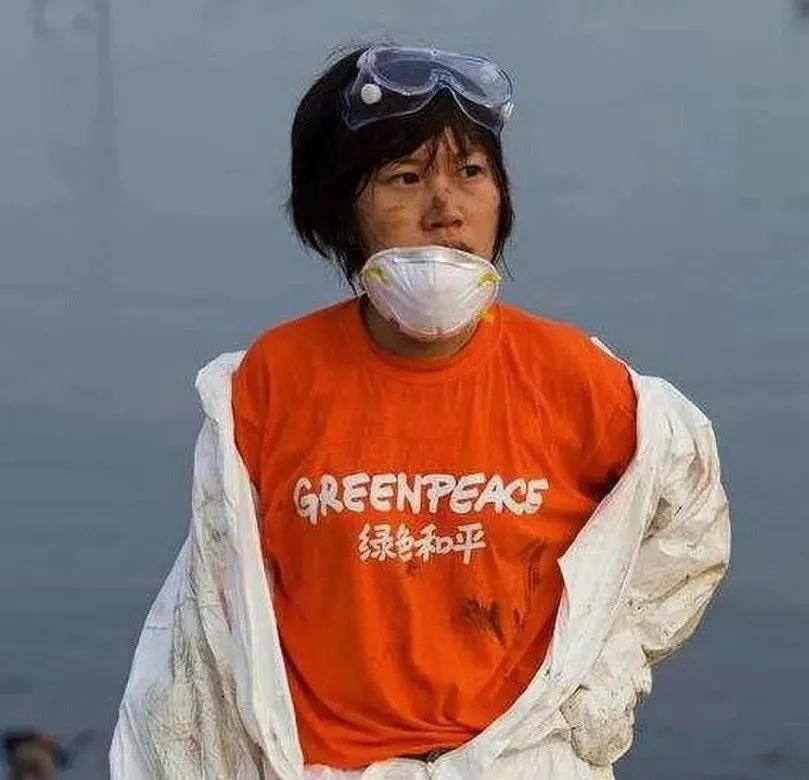
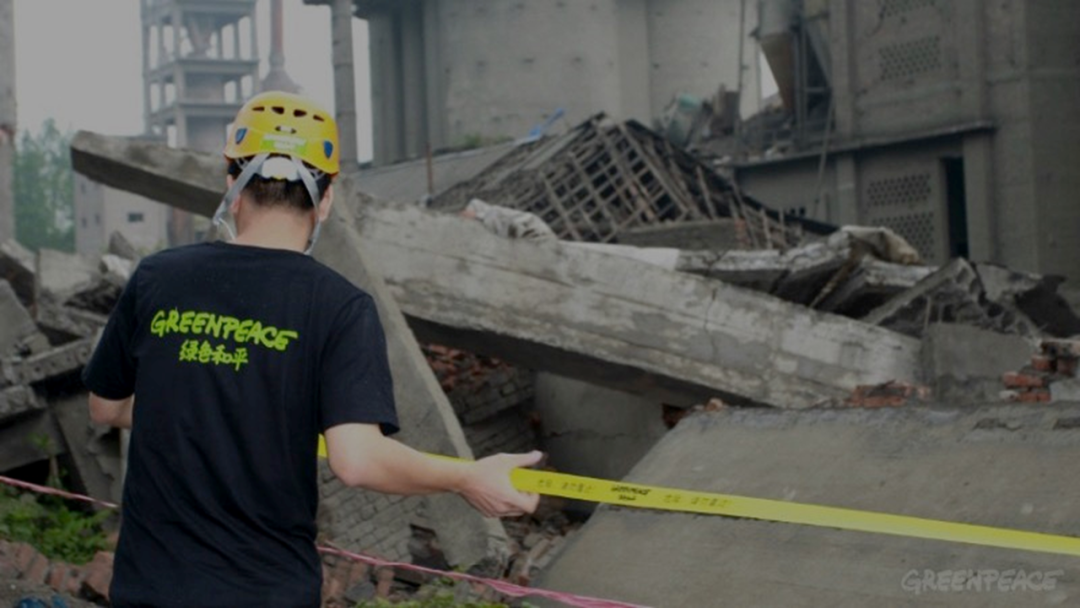
Let me give two examples. The first is the 2008 Wenchuan earthquake. I had just joined Greenpeace; that year was also called the year Chinese philanthropy exploded – every charity wanted to help, and the roads to Wenchuan were completely jammed. In a sudden crisis like that we all want to take part, because we’re all people who want to give, but what can we do? We need to be clear about our role. So what did Greenpeace choose to do? Monitoring and preventing secondary environmental disasters. What’s a secondary environmental disaster? The first event is the explosion; the problems that follow from it are secondary. Wenchuan was an earthquake, a geological disaster, but Sichuan has many small, medium and large chemical plants. State-owned ones are overseen by the government, but many private companies, even small workshops, had no one overseeing them – and if even one barrel of chemicals flows into rivers, lakes or seas and leaks into the environment, the damage to the environment and to human health is enormous. These needed to be managed. So we went to fill the gaps. We sent out our rapid response team with professional equipment – you can see our colleagues wearing helmets, gas masks and face masks, and putting up a cordon, because they had found a chemical storage tower that was about to collapse, so they cordoned it off to keep local people away. After gathering evidence right away, we handed the material over to the Ministry of Environmental Protection’s Southwest Supervision Center. That’s how we found environmental hazards and helped prevent secondary disasters.
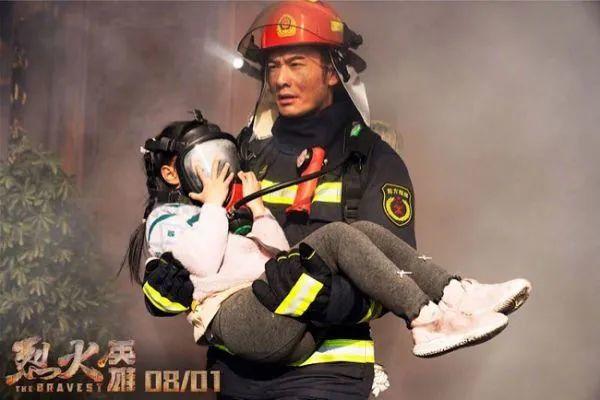
The second kind: this photo is of me in Dalian in 2010. Have you seen the film The Bravest (烈火英雄), starring Huang Xiaoming, about firefighters? It was based on this event: as an oil tanker was unloading in Dalian, something went wrong and the oil pipeline exploded. The explosion polluted the whole sea surface, and a firefighter lost his life. As an environmental organization, we felt we had to do something. The information in the media was very limited, so as a professional organization we wanted to go and see what was really going on. We went with all our equipment and our specialists.
I work on government relations. In all our work, whatever we find, we communicate and report it to the government departments right away, because we don’t have the capacity to solve the problem. We can only put up a cordon to keep people away; we can’t remove the hazardous materials. So our role is really to fill in the gaps. Those who truly solve the problem are others: we are not the main force solving the problem; we are an accelerator of the solution.
Now, we also need to do positive things. I’ve talked a lot about exposing problems, and exposing problems is part of our DNA, but we also have to do a lot of things that fit the times: besides finding problems, we also need to recognize positive efforts by all sides. So on some major events we use our particular strengths as an international organization. For example, around the 2008 Beijing Olympics and Beijing’s 2015 bid for the Winter Olympics, there were two kinds of voices: the government said everything was fine, while the international media carried a lot of negative information. I remember one of the biggest stories was that American marathon runners put on masks as soon as they got off the plane, because they didn’t know what China would be like. So as an independent third party that takes no money from government or business, we produced an independent environmental assessment report. In it we described Beijing’s efforts, some of Beijing’s shortcomings – which we called missed opportunities – and Greenpeace’s recommendations. Unexpectedly, the report received special attention from all sides, from the International Olympic Committee to the UN Environment Programme to the Beijing Olympic organizing committee, all of whom valued it because ours was an independent third-party voice. So in 2015, when Beijing bid for the Winter Olympics, the evaluation commission came to Beijing and specifically told the Beijing municipal government that they wanted to meet Greenpeace and hear what Greenpeace had to say: was Beijing’s air really that dangerous, could it host such an international sporting event? So we were invited by the Winter Olympics evaluation commission to brief them on Beijing’s environmental situation. This kind of independent, credible third-party voice is, I think, what makes us valuable in China – the foundation that earns us recognition from all sides and lets us survive. That’s in China. Internationally there’s a similar example, a bit like the Olympics one: in the UN climate change negotiations there are many international misunderstandings about China – China has done so much, yet it keeps coming under a lot of pressure in the negotiations. So Greenpeace also acts as a kind of independent civil-society commentator on China, speaking with our own independent voice: good is good and bad is bad – we can neither only praise nor only criticize.
In this new era we’re also doing a lot of innovative work, such as what we call a nonprofit clean energy incubator. We want to learn from the business world. Although we don’t accept donations from businesses, I think the business world is the most dynamic source of innovation, so we want to draw some nourishment from it. We run small clean energy incubators, hoping to help small clean energy entrepreneurs connect with angel funds and resources, or build their capabilities, so they can stand out in the startup world. This is what we call “enable” – empowerment; we call ourselves an empowering organization, using our international strengths to help these small individual entrepreneurs, especially in the energy sector, grow. Not everything has to be done by us ourselves.
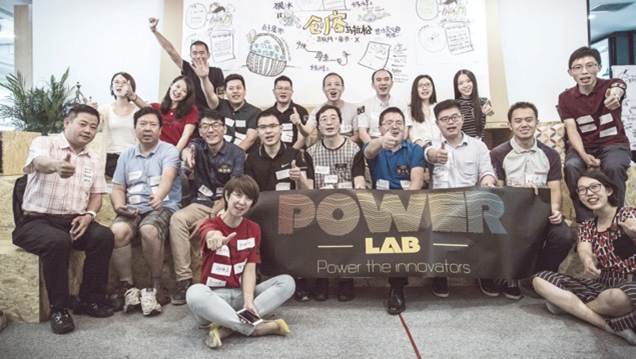
Now, this is the example our friends earlier were most interested in. Sustainable agriculture doesn’t mean every project must be sustainable; sustainable agriculture is a new term in response to the old farming that overused chemical fertilizers and pesticides. We don’t say organic agriculture or green agriculture because it may not yet be possible to be fully organic, to use no fertilizers or pesticides at all, so we use the term sustainable agriculture. We see that many entrepreneurs doing sustainable agriculture have a very hard time because their capacity is limited: if they focus on growing produce, they can’t sell it. So we felt we needed to connect them to networks. What we do is connect them with government support and with commercial platforms – supplying through JD.com, crowdfunding, connecting them with consumers – so that their rice is all sold before it’s even harvested. In this way we support these local sustainable farmers, just as we support small business innovators. Through these connected networks, by bringing stakeholders in, we help them grow.

Finally, why do we say “think globally, act locally” – in English, global thinking, local action? For this picture I chose an image of Tiananmen and air pollution. The blue part is what it looks like without air pollution; the gray is what it looked like in the winter of 2013, when air pollution was especially severe. So blue is our goal, and gray is perhaps the challenge we face today. For us, the world outside is changing, so Greenpeace has shifted from focusing on exposing problems – especially since coming to China – to telling people that we are able to solve problems, and even where we can’t solve them ourselves, we will develop solutions and create platforms for solving them, so everyone can work together to solve them. And the non-violent direct action we used so much before – in China we don’t do non-violent direct action; we do public participation. We believe that only when all sides act together can we drive positive change, because environmental protection was never just our own business; it concerns everyone. We believe our vision is the same as the government’s, as business’s, as every member of the public’s. We have no enemies; we are all comrades-in-arms. So only by connecting more people to act together can we drive positive change.
That’s basically it. Thank you. (Click the audio below for the lively discussion.)
Editor’s note: want to hear the discussion of the questions below? Click the audio above.
- How does Greenpeace keep following up on each environmental issue?
- How does Greenpeace research and select issues? How does it work with experts and public figures?
- How did Greenpeace find its mission as it grew, and how did it reach what it has achieved today?
- How does a newly founded charity grow, and how does it do media outreach?
- How does Greenpeace mobilize volunteers, and how is it managed internally?
- Finally, audience comments and the guest’s closing remarks
Visit Greenpeace’s official website: Greenpeace | Positive Change Through Action (greenpeace.org.cn)
Recent Comments