
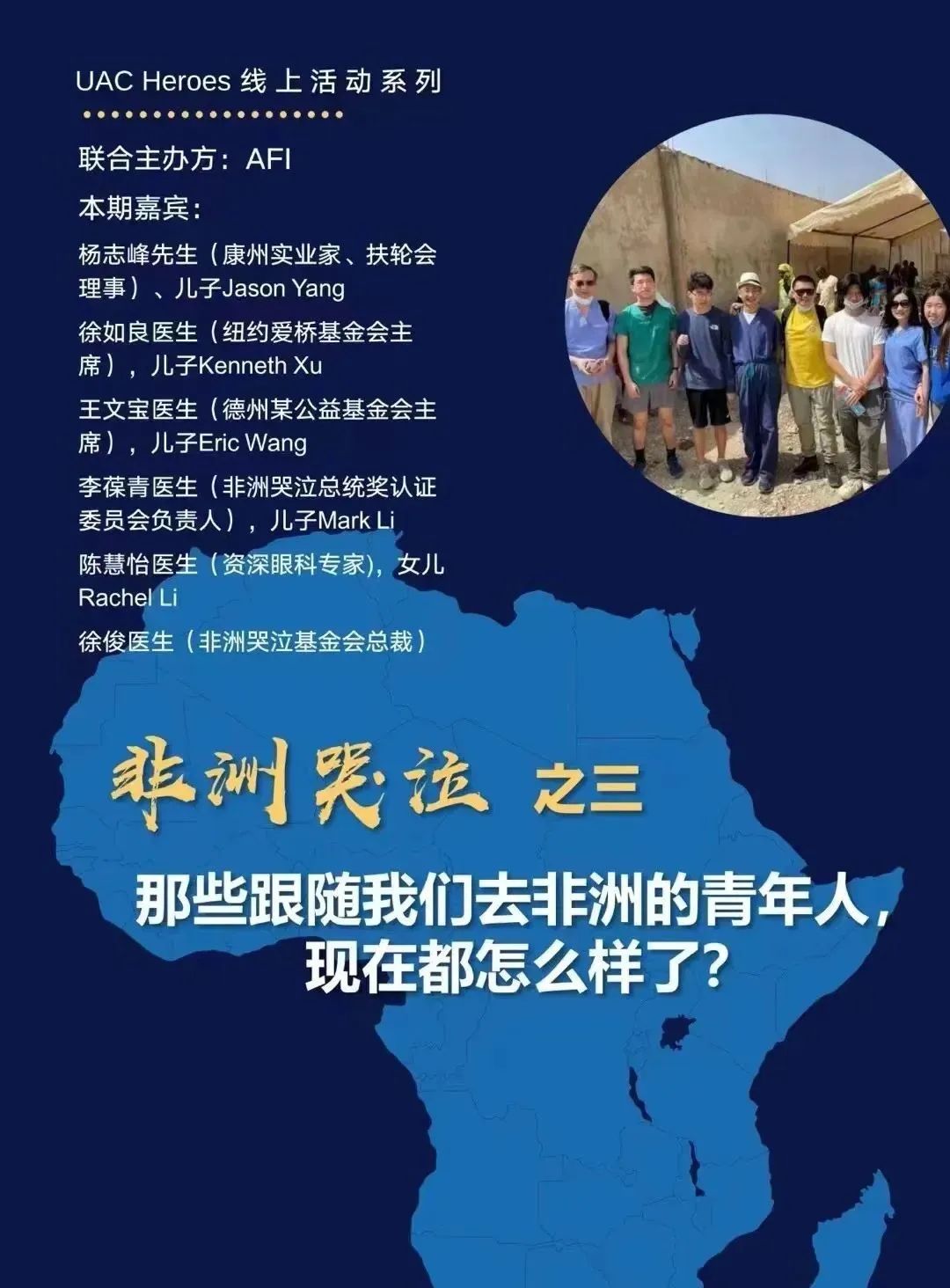
Introduction:
“Dad, I will never, ever, ever complain again.” That is what Dr. Jun Xu’s son told him on a flight home from Africa.
For years, Dr. Jun Xu and his Africa Cries Out team have carried out charitable work in remote leprosy villages in Senegal, West Africa. Since 2013, together with several other doctors, he has traveled many times to this isolated place to treat the sick and injured, helping to set up a clinic and found the Dakar technical school. Despite extremely harsh conditions, scarce funds and resources, and even an Ebola outbreak, they have done everything they can to serve their patients.
This time we invited Dr. Xu and five families who took part in this year’s volunteer trip to Africa to share their experiences. We heard how Dr. Huiyi Chen’s daughter Rachel made posters before the trip, calling on her school to donate shoes and computers to bring to Africa; how Mr. Zhifeng Yang described the trip as an experience that changed his outlook on life; and how Dr. Ruliang Xu shared his belief that the best way to raise children is to let them observe society with their own minds and eyes, draw their own conclusions, and then decide what they want to do in the future…
For all these moving stories and reflections, please watch the talk via the video below. (Dr. Xu and the five families speak for the Africa Cries Out foundation and for themselves, not for UAC.)
“Having the ability to help others, and the opportunity to actually do it, is deeply meaningful in itself. When you help others, you bring them change and joy – and at the same time you feel the joy it brings you. Then, when your children grow up and become independent, they will still want to keep doing the same. That is a very precious lifelong gift we as parents can give our children.”
– Dr. Huiyi Chen
Q&A
Here are some of the questions and answers from this session:
Q: Which vaccines are needed before going to Africa? Is there a problem with overuse of medical care in Africa?
A:
For travel to Africa, we recommend following the US CDC’s vaccination advice. Yellow fever is required; typhoid and malaria prevention are recommended but not required.
Overuse of medical resources is rare there, mainly because people pay for medical care themselves, so they only come when they are unwell.
Q: What illnesses do the doctors mainly treat in Africa?
A:
Infectious diseases such as parasites, roundworm and hookworm, and complications they cause, such as anemia. Fungal infections are also common. Because of local eating habits, there are cases of high blood pressure.
There are also symptoms such as headaches, stomachaches, abdominal pain, diarrhea, fever and lung infections.
Q: Can someone without a religious faith apply? Are there any requirements?
A:
Some of the doctors who went to Africa with us this year are not Christians, and we all got along wonderfully. Whatever our religion or social status, we go as volunteers – it doesn’t matter who organizes the trip. We go to give our resources, our skills and our abilities to do whatever we can.
Q: Is language a barrier when communicating with local patients? Do the locals speak French?
A:
We had two interpreters on our team. I spoke English, one interpreter translated it into Portuguese, and the other translated the Portuguese into French. Then a local French speaker translated for the patient. (Dr. Ruliang Xu’s blog has a more detailed account:
https://aliangphotos.com/senegal-medical-charity-trip-3-30-3-20-2022-%e5%a1%9e%e5%86%85%e5%8a%a0%e5%b0%94%e5%8c%bb%e7%96%97%e6%85%88%e5%96%84%e4%b9%8b%e6%97%85-2022-%e5%b9%b4-3-%e6%9c%88-10-%e6%97%a5%e8%87%b3-20-%e6%97%a5/)
Q: How do I sign up for next year’s trip?
A:
Please contact Dr. Jun Xu – the team announces the itinerary about six months in advance. Trips currently take place around March or April. Registration is announced on the website; you can log in, fill out the form and send it to Dr. Xu. (Dr. Xu’s WeChat ID: jun9174343767; Africa Cries Out website: http://www.africacriesout.org)
And some questions and answers from earlier talks (to answer as many questions about the Africa trip as possible)
Q: When did the Africa Cries Out foundation begin operating?
A:
It officially began operating in 2013 and has five main programs: education, medical care, poverty relief, nonprofit enterprise and youth ministry.
We have two hospitals in Africa. One is in Senegal (in West Africa, with a population of 15 million – about the size of a very small Chinese province; in 2020 average annual income per person was only $1,356, a very poor country), about a 15–30 minute drive from the capital, Dakar. There we built a hospital offering internal medicine, pediatrics, obstetrics and gynecology, and family medicine. We hired local doctors, nurses and pharmacists, and it has six beds. A visit costs less than two dollars, and medicine is free.
To relieve hunger and poverty, we provide about $30,000 worth of grain, vegetable oil and other goods every year, and our children and youth ministry go to help.
Our nonprofit enterprise provides brick-making machines, egg incubators, commercial bread machines, water wells and so on, and we have registered a company in Senegal.
Chinese children began joining the youth ministry in 2017 and 2018. Some go again and again, because they see the need there and help meet it, realizing the value of their own lives. Going to Africa isn’t about enjoying yourself – it’s about giving and contributing.
The children get up in the morning to make breakfast for everyone and help the doctors hand out medicine. Back home, they help design the website and translate between Chinese and English. They help collect old shoes for African children, and used laptops and phones such as the iPhone 7 and iPhone 8 to send to Africa; the schools are very, very grateful and welcoming.
Q: Questions about going to Africa
A:
Budget per person: from the US, the flight is under about $1,000. For food and lodging we charge about $800 (we buy food in the US and check it in to bring to Africa, we avoid local water, and we brush our teeth with branded bottled water); you stay about seven or eight days and need meals and transport. On top of that comes our suggested donation of about $1,000 per family. Altogether that comes to roughly $2,800 per person, all self-funded.
Language: if you want to go, you need some English; French is even better, as it is the official language there.
Visa: holders of mainland Chinese passports should apply for a visa in advance (get a tourist visa – saying you are going to volunteer invites a lot of scrutiny). US passport holders get a visa on arrival.
Must a parent come along? Middle-school students (under 13) generally need a father or mother to accompany them; high-school students can go on their own.
What do children from mainland China need? A passport, ideally an accompanying adult, and all the recommended vaccinations in advance – otherwise they risk malaria, yellow fever and diarrhea there.
Is there a limit on group size? In recent years each group has had about thirty-some people. 2019 was the largest, with over forty – even the biggest bus was packed full. The main challenge locally is transport: the leprosy village is about 700 km from our base, a 13–14 hour drive. About ten people from our own team go each year from the US, including volunteers, children and their parents.
To join a group, should we contact Dr. Xu directly or follow the website? You can contact Dr. Xu directly. (Dr. Jun Xu, WeChat ID: jun9174343767)
Plans must be confirmed at least six months ahead. Trips currently take place around March or April. Many of our fellow travelers are doctors whose schedules are tight, so we must confirm at least six months in advance.
Doctors should bring their medical license: if you hold a formal medical license – from the US, China or any other country – be sure to carry it with you.
When to go: avoid summer vacation, which falls in the rainy season. The rainy season runs about three months, June to August, and we cannot go then: there are many mosquitoes, which spread malaria, yellow fever, encephalitis and other diseases. Going in March or April means arriving at the end of the dry season. The mosquitoes have basically all dried up and died, so there’s no need for mosquito nets – just bring long-sleeved clothes.
Children need to take time off school. Let the school counselor know and get their approval. Children should also bring their own iPad or computer, since their classes and homework are online; they can buy a data plan at the airport there and keep up with their regular classes online.
If we go during spring break, we schedule around most children’s break, since US schools don’t all have spring break at the same time; the few children with conflicts need to arrange time off.
How long: usually ten days – two weekends with five days in between, plus flight time, generally nine to ten days. Children and parents from mainland China fly directly from China to Senegal and meet us there.
Get vaccinated about one to two months ahead. The CDC website lists the recommended vaccines (yellow fever, malaria, hepatitis A), or your family doctor can tell you which ones you need. (In the US) with insurance or health coverage, vaccines are generally free.
What to bring: some laxatives, mosquito repellent, sunscreen, long-sleeved clothes, and a sweater or fleece.
If I bring my child, how do we avoid local infectious diseases? The risk of catching an infectious disease is basically very small – in all our many trips, no one has caught any.
Q: What do the children usually do there?
A: Our youth team has plenty to do there.
First, they help us hand out medicine and take part in the medical work, which makes them feel useful.
Second, they help us with poverty relief, distributing grain, vegetable oil and other goods.
Third, and very important, they take part in our logistics. At breakfast, for example, the children get up earlier than we do. They split into teams: the first prepares that morning’s breakfast, the second prepares the next day’s. At lunchtime they help clear the dishes. This gives them a sense of belonging. That’s why many children on my team have gone for years – three or four years now – and still want to go back, because they know they can contribute something there for the African people and for the team.
Q: What about personal safety there?
A:
Our team has never had any problems. We travel as a group, and wherever we go we are led by local co-workers who know where it is and isn’t safe to go. In all our years of going, we have never once been robbed or had any trouble of that kind. For transport we ride a very large bus, so road safety is assured.
Senegal, where we go, is a very orderly country. Its founding president was a Christian, and its later leaders have guided the nation by the most orthodox teachings of the Bible and the Quran, so the country is very well run and the roads and towns are clean. Violent crime isn’t common – I can’t say it never happens – but we don’t go to dangerous places.
Q: Can the President’s Volunteer Service Award be earned from mainland China?
A:
The President’s Volunteer Service Award is only for US citizens; it is presented by the US President in recognition of volunteer service. It has hour requirements that vary by age group, with gold, silver and bronze levels, a certificate, and a congratulatory letter from the White House signed by the President.
For children from mainland China, Africa Cries Out can provide a recommendation letter, or an evaluation and feedback.
If you can’t make this trip to Africa, there are other ways to take part in our international work in Africa: building the website, collecting things such as shoes and iPhones locally in the US, helping spread the word, and so on – whatever help you are able to give.
Q: Do you need Chinese-language teachers?
A:
Not for now, probably – what they need most is French and English.
Q: How can we donate to the foundation?
A:
Under the relevant national regulations, we cannot accept donations in RMB – please forgive us. But we are a tax-exempt charity approved by the US government and can accept donations from outside mainland China.
If you are moved and would like to support our work in Africa, please write a check to Africa Cries Out and mail it to Jun Xu, MD, 1171 E Putnam Avenue, Riverside, CT 06878, USA
Zelle: Africacriesout@gmail.com
Or donate online by credit card (the card company charges a processing fee): http://www.africacriesout.org
You will receive an IRS-recognized tax-deductible receipt.
Our team solemnly pledges that 100% of your donation goes to the people of Africa – we spend not a cent on administration, and our team pays its own way to Africa! Thank you for your loving support! Visit our website for full information. If you would like to join our work, please contact Dr. Jun Xu.
Jun Xu’s WeChat: jun9174343767
WeChat official account: LifeExploring (Heavenly Road of Life)
http://www.africacriesout.org
Related articles (in Chinese):
UAC Online Event Review: Africa Cries Out, Part 1 – Our Guest Dr. Jun Xu
Cover Story | Africa Cries Out: Schools That Kindle Hope
Rapid Progress on the 6,000 sq ft Student Dormitory – Africa Cries Out Report 2021 No. 011
The Technical School’s Second Class Graduates – Africa Cries Out Report 2021 No. 06
Recent Comments